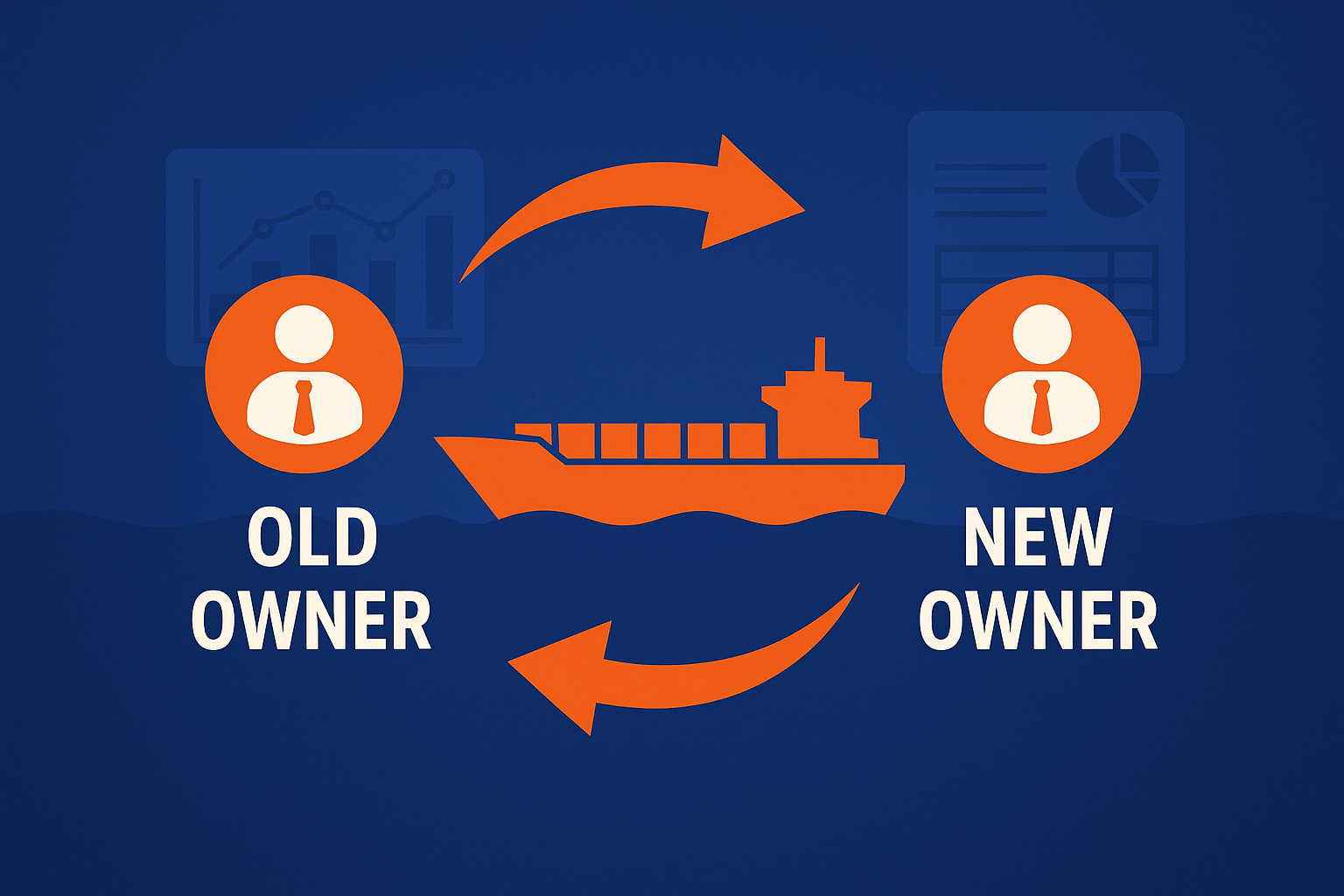
Vessel Takeovers- DCS/MRV Compliance

Introduction:
As fleet transitions accelerate across the industry, vessel takeovers demand meticulous attention to regulatory continuity. Missing or delayed compliance documentation can cascade into certification risks, operational disruptions, and exposure to penalties—especially under IMO DCS and EU and UK frameworks. This guide outlines the essential records and plans to secure from previous owners/managers and to prepare with your Recognized Organization (RO) prior to takeover, ensuring uninterrupted compliance .
Why this matters now
* Certification timelines are tightening: Verified fuel consumption and statements of compliance underpin 2025 certifications under IMO DCS.
* EU and UK oversight is expanding: EU and UK MRV/ETS and Fuel EU Maritime requirements apply for voyages touching EU ports and waters, with partial-year statements critical at change-of-management.
* Data integrity is key: Raw voyage data and supporting evidence (BDN, cargo docs, log books ) are increasingly scrutinized.
Preparation of plans
Once the takeover is confirmed, the following two plans to be prepared and to be approved by the Recognized Organization (RO)
1. SEEMP Part II
2. SEEMP Part III
Ensure that these plans are well within the frame work of the company SEEMP Part 1. In addition both the plans to be in line with the 2024 guidelines.
Post-takeover , evaluate the trading pattern of the vessel and prepare and get approvals for
3) EU MRV Monitoring Plan, if the vessel is planned for EU voyages.
4) Fuel-EU Maritime plan, if the vessel is planned for EU voyages.
5) UK MRV plans in case vessels has planned port calls to UK for cargo operations.
6) Add vessels to your UK METS account within 14 days of take over.
7) In case you are taking over responsibility of ETS obligations under EU and/or UK ETS regulatory frame work, ensure that mandates from owners are obtained . Do note that hard copies with wet stamp and signatures are preferably to be obtained and maintained on record.
Historical documents
The main documents to obtain from the previous vessel operator under each reporting regime , and the areas of concern to be addressed are as follows:
IMO DCS :
1. Previous years Statement of Compliance (SoC) and verified Fuel Oil Consumption Reports ( FOCR)
2. Statement of Compliance and verified Fuel Oil Consumption Report till the date of takeover.
These documents are essential to ensure timely certification of the vessels in and to avoid gaps in annual reporting continuity. As a minimum the above documents should be availabe at least for the past 3 years to allow for SEEMP3 evaluation and planning.
EU -UK MRV /ETS and Fuel-EU Maritime (applicable if the vessel has EU voyages in previous and current reporting year)
a) EU MRV Document of Compliance for previous reporting years starting with 2024
b) Verified partial EU MRV statement up to the takeover date for current year.
c) Document of compliance for Fuel EU for the previous reporting years, starting with year 2025.
d) Verified partial compliance statement for Fuel-EU Maritime up to the takeover date for current year.
e) In case vessel has not had any voyages under MRV/Fuel-EU scope till date of take over, a Zero emission report to be obtained and recorded in Thetis. This is not a mandatory requirement as per the regulatory frame work and in case this is not provided by the previous operators, a declaration by the vessels accredited verifiers or Class that vessels has not had any EU voyage in current reporting period till date of take over is preferred.
f) Clearly verify the flexibility mechanism opted by the vessels to meet the Fuel EU obligations in the previous reporting years as both Borrowing and penalties come with additional burden on vessel.
g) Ensure that once the vessels is added to Thetis, check and ensure that the ICB and partial verification of MRV are found in order and reports available for download- both will impact your ability to complete timely annual reporting at the end of the take over year.
h) Take over MOA to have clear path way defined to ensure ETS and Fuel EU obligations during the previous operators period are met, without financial burdens coming onto current managers or owners.
i) If there are any UK MRV or UK ETS obligations under the emissions under the previous operator have been recorded in METS for inclusion into their Annual Emission Report( AER)
These items provide traceable evidence of monitoring, reporting, and verification across the vessel handover, and ensure accurate aggregation of annual emissions and energy metrics.
Verification of equipment and associated documents
With revisions in the SEEMP2 bringing in additional granularity and added focus to the reporting of fuel consumption from individual consumers , it is recommended to check :
* The details of the fuel measuring instruments such as flow meters and other tank level gauging systems.
* Sight and ensure availability of type approvals for the measuring instruments.
* Establish maintenance routines for these instruments in line with maker recommendations.
* Ensure calibrations are done and certificates available as per maker recommended intervals.
Practical steps to ensure smooth transition
* Define a cut-off date : Agree in writing, say as part of the MOA for the take over, for obatining all required certification from previous operators.
* Request auditor confirmations: Where possible, obtain verification body sign-off for partial-year statements to avoid rework.
* Standardize data formats: Ensure MRV raw data (voyage logs, BDNs, cargo documentation) arrive in machine-readable formats consistent with your reporting systems.
* Cross-check identifiers: Confirm IMO number, company IDs, reporting period references, and voyage boundaries match between DCS, MRV, and FuelEU datasets.
* Maintain an audit trail: File correspondence and versioned documents centrally for future Port State Control or verifier queries.
Conclusion.
* Verify records ion Thetis and METS accounts to ensure that you are updated and in compliance with no road blocks to meet your annual reporting deadlines.
Conclusion:
A disciplined approach to document collection and plan approvals at takeover safeguards certification timelines and operational flexibility. By securing verified partial-year statements, raw evidence, and RO-approved plans ahead of the handover, and ensuring that financial obligations associated with ETS and Fuel EU regimes are clearly addressed in agreements, owners and managers can maintain compliance continuity and minimize regulatory risk.