Anatomy of a PoS

Introduction
As the maritime industry progresses in its decarbonization journey, biofuels are becoming a practical drop‑in solution to reduce greenhouse gas (GHG) emissions from existing fleets. This process has been further accelerated with the Fuel EU regulatory frame work of the EU. However, using bio fuels for compliance or voluntary decarbonization targets is not just a matter of bunkering the fuel. Without proper documentation, the claimed emission reductions may not be recognized by regulators, charterers, cargo interests or internal ESG reporting.
This is where the Proof of Sustainability, or PoS, becomes critical. This article makes an attempt to capture the essence of the PoS and its contents without going into the Regulatory frame work such as Fuel EU, RED and ISSC. The aim is to look at the PoS form the perspective of a Chief Engineer, Technical Superintendent or commercial operator- people at the front line of Bio Fuel usage who merely need to understand what the PoS is all about, and what to check for ensuring that it serves the purpose.
What is a Proof of Sustainability Document?
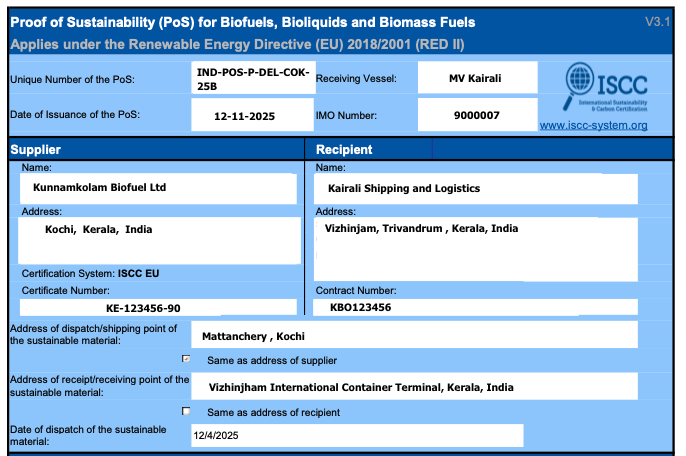
A PoS is the key document that links a specific quantity of biofuel to its certified sustainability performance. For ship operators, understanding the structure and content of a PoS is essential to ensure that the right fuel, from the right feedstock and pathway, is correctly matched to the right voyage and Bunker Delivery Note (BDN).
A Proof of Sustainability provides this evidence in a standardised format, issued under a recognised certification scheme (for example, ISCC, RSB or other approved schemes). The PoS is therefore:
* The legal/contractual basis for claiming emission reductions
* The primary document that auditors and verifiers will request when reviewing voyages using biofuel.
* A key part of the evidence package alongside BDNs, logbooks and consumption records
Why is a PoS required while taking Bio Fuel?
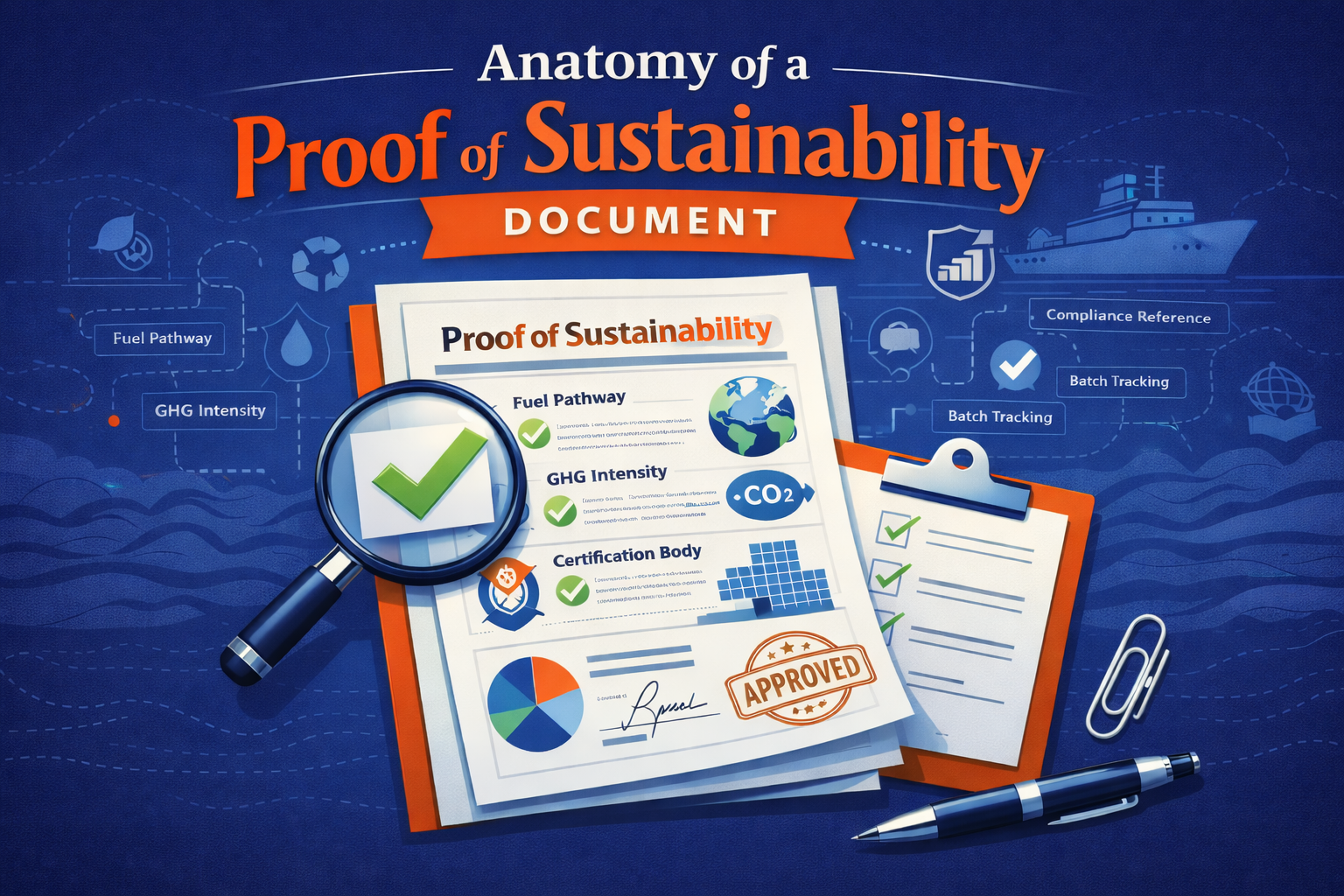
While formats differ between certification schemes and suppliers, most marine biofuel PoS documents contain the following core elements:
a) Supplier and certification details
* Name and address of the certified supplier
* Certification scheme name (e.g. ISCC, RSB) and version
* Certificate number and validity period
* Name of certified entity (trader/producer) and scope of certification
b) Product identification and feed stock information
* Type of Product (e.g. “BIODIESEL).
* Type of raw material ( eg Used cooking oil ( UCO) entirely of vegetable origin.
* Country of Origin of the raw materials
* Chain of custody model (e.g. mass balance)
* Reference to the applicable sustainability standard and methodology
* Statement that the batch complies with sustainability criteria under that scheme
c) Batch and quantity details
* Unique PoS or batch number
* Quantity of sustainable biofuel covered by this PoS (in tonnes, m³, or energy)
* Delivery or production date and, where applicable, batch validity period
d) GHG data and emission factors
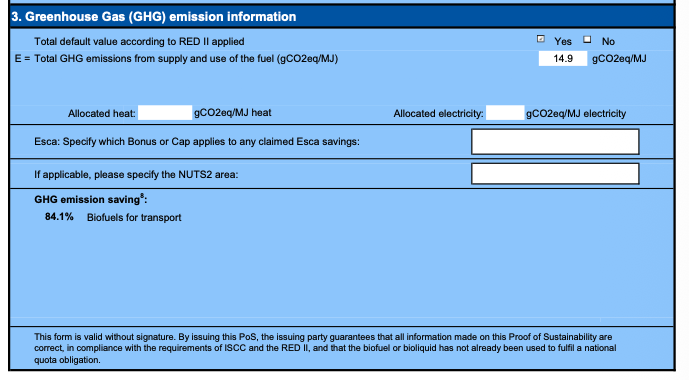
* Life-cycle GHG emissions of the biofuel (e.g. gCO₂eq/MJ)
* Method used (default values vs. actual values)
* Calculated GHG savings compared to a reference fossil fuel
* Any additional parameters required by specific regulations (e.g. FuelEU, RED II/III
What should be checked when a ship received a PoS?
When you receive a PoS from the supplier, it should be reviewed with the same care as a BDN or quality certificate. As a minimum, ship operators (and their technical/operations teams) should check:
a) Validity of the certification
* Is the certification scheme recognised for the purpose you need (e.g. EU ETS / FuelEU)? Normally ISSC, RED II or RED III is stated at the header of the certificate.
* Is the certificate number clearly shown?
* Is the certificate validity period covering the date of delivery?
b) Matching of supplier and counter party
* Does the certified entity on the PoS match the contractual seller or the entity that actually supplied the fuel?
* If different entities are involved (producer, trader, physical supplier), is the chain of custody clear?
c) Product and feedstock consistency
* Does the product name and type on the PoS match the agreed fuel (e.g. UCOME, HVO, FAME blend)?
* Is the feedstock type consistent with what was contracted (for example, Used Cooking Oil vs. another feedstock)?
* If your internal policy or charter party allows only certain feedstocks (e.g. waste-based), is this clearly indicated?
d) Quantity and batch coverage
* Is the quantity on the PoS equal to, or clearly covering, the quantity on the BDN in case of pure Bio fuel?
* If the PoS is for the biofuel part of a blended fuel is the quantity given in line with the fractions mentioned in the BDN. (Eg. B30 Biodiesel blend means the PoS associated with 100 Tons of this B30 Blend should mention approximately 30 MT of the Biofuel part. The other 70 MT being marine diesel oil.)
* If the PoS covers a larger batch than what was delivered to your vessel, is there a clear sub-batch reference or allocation?
* Are units (tonnes, m³) clearly indicated and convertible to BDN figures?

e) GHG data completeness
* Does the PoS provide a specific emission factor (e.g. gCO₂eq/MJ or tCO₂eq/tonne)? Known as the E value this is one of the most vital information oil the PoS.
* Does it show the percentage GHG savings compared to the reference fossil fuel? This emission savings should normally be be 70% or above of 94gmCO2 eq/MJ.
If any of these points are unclear, operators should revert to the supplier and request clarifications or a revised PoS before relying on it for reporting or compliance.
Connecting the BDN to the PoS
For the emission reduction claim to be accepted, auditors must be able to follow a clear trail from:
PoS → Bunker Delivery Note → Shipboard records → Emission / compliance report.
To achieve this, operators should:
a) Align batch and reference numbers
* Ensure that the PoS includes a unique batch or PoS number.
* Record this PoS number on the corresponding BDN.
b) Match quantities and dates
* Delivery date on the BDN should fall within the validity/batch period stated on the PoS.
* The BDN quantity of biofuel (or biofuel content in a blend) should not exceed the quantity covered by the PoS.
* If multiple deliveries are made from the same PoS batch, document the allocation of quantities among BDNs.
c) Integrate PoS into your documentation process
* Treat the PoS as a mandatory document for any biofuel stem, similar to the BDN and fuel quality analysis.
* Store PoS documents in your central document system under the relevant vessel and voyage.
* Include checks for PoS and BDN alignment in your internal audit or SEEMP/ISMS procedures.
d) Reflect in reporting and verification files
* When preparing DCS/MRV, EU ETS or FuelEU Maritime data, use the emission factor from the relevant PoS for that batch.
* Attach or reference the PoS in the evidence package shared with verifiers.
* Ensure that voyage-level biofuel consumption in your reporting system is clearly linked to the corresponding PoS/BDN combination.
Practical steps while receiving Bio Fuel Bunkers:
For every biofuel delivery, ship operators ensure that the following points are covered
1. Before bunkering:
* Confirm that the supplier will issue a PoS under an accepted sustainability scheme.
* Confirm feedstock type, product, and expected GHG savings in the contract.
2. On receipt of PoS:
* Verify certification scheme, certificate number and validity.
* Check that product, feedstock and buyer details match the contract.
* Confirm quantity, batch number and GHG data.
* Record PoS number and file the document properly.
3. Linking to BDN:
* Ensure BDN shows the correct product description and quantity.
* Cross-reference PoS number with BDN number and vessel/voyage.
* Document any allocation if a PoS batch covers multiple deliveries.
4. For reporting and audits:
* Use the PoS emission factor in your calculations.
* Keep PoS and BDN copies readily available for verifiers.
* Include PoS/BDN checks in your internal procedures.
Conclusion
Biofuels can provide a meaningful and immediate reduction in GHG emissions for existing tonnage, but only if the sustainability attributes are properly documented and traceable. The Proof of Sustainability is the central document that connects the certified biofuel batch to the ship’s actual consumption and to your regulatory and ESG reporting.
By understanding the anatomy of a PoS, carefully checking its content, and ensuring a clear link between PoS and Bunker Delivery Note, ship operators can:
* Protect themselves against non‑compliant or mis‑sold product
* Secure recognition of their emission reductions under applicable regulations
* Build transparent, credible decarbonisation records for their fleets
In short, every tonne of biofuel you bunker should be backed by a valid PoS that you understand, verify and can confidently defend during any audit.