ISM Managers & Fuel EU Flexibility Mechanisms

Ship Managers and Fuel EU Flexibility Decision
The clock is ticking on Fuel-EU Maritime compliance — and there is one aspect of Fuel EU that ship managers need to get clarity on: will there be penalty payments or will the stakeholders opt for flexibility mechanisms like pooling
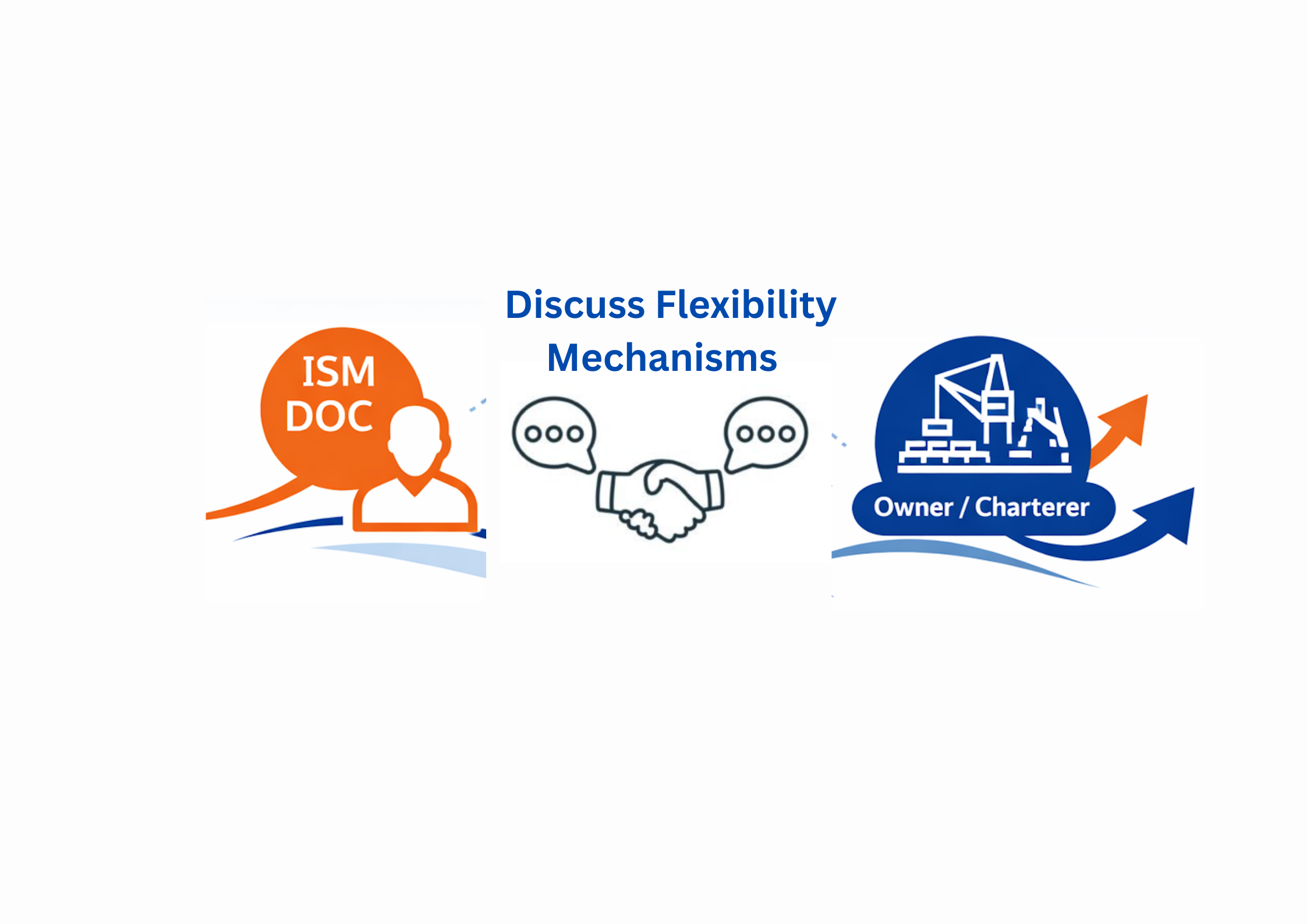
As the ISM manager, you are the responsible party for Fuel EU compliance — but you are often not the final decision maker in handling the financial implications associated with this regulatory framework. Pooling decisions typically rest with owners, and charterers frequently influence operational choices that affect compliance performance.
With the deadline of Fuel EU submissions approaching fast, and decisions on whether to follow the penalty, borrowing or pooling path way will enable smooth verification and compliance leading to timely issuance of the Document of Compliance.
Engaging with the stake holders whose vessels you manage is very much the need of the hours so that decisions are not left to the last minute, affecting the final verification process.
The Unique Challenge for ISM Managers
As the ISM manager, you are the responsible party for Fuel-EU compliance — but you are often not the final decision-maker. Pooling decisions typically rest with owners, and charterers frequently influence operational choices that affect compliance performance.
Yet when penalties payments arise, the financial burdens, the operational and reputational impact lands squarely on the ship manager.
This creates a clear imperative:
You cannot wait passively for decisions to arrive. You must actively initiate and structure the discussion with owners and charterers — now.
Delaying these conversations reduces your chances of timely compliance, as the path for the certification is also dependent on the choice of the flexibility mechanism-
A) if the vessels goes in for penalty payment, then it is the Administering Authority that will do the final verification of the payments and issue the DoC
B) while if Pooling is opted for, the process continues with the pool verifiers and ultimately it will be the vessels verifier that issues the DoC.
An early understanding of the vessel's choice of pathways for the Fuel EU compliance will make the process flow easier and in most likely hood, very much economical.
The Pooling Decision: Why It's worth discussing
Among the various flexibility mechanism Pooling allows you to work together with other vessel owners and managers to ensure more economical and reliable solutions to compliance . Borrowing and penalties both come with the added burden of interests which are to be paid in the consecutive years of negative compliance balance, whereas Pooling provides closure for the reporting year.
Consider the below extract of an actual vessel form Fore-C emission data management platform:
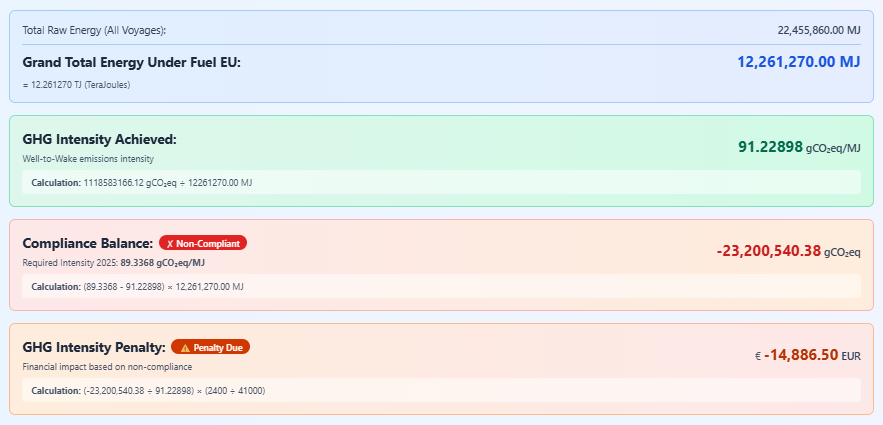
With a negative compliance balance of 23.2 tCO2 Equivalent this vessel is looking at a penalty payment of Euro 14,886.50.
With pooling , with asking prices of compliance balance in the range of 230-250 Euro per ton, this same vessel can purchase the required compliance balance at a cost not exceeding Euro 5500. As seen here , the cost of penalties is 3 times that of opting for pooling !
To achieve these benefits, we recommend that managers initiate the discussion and ensure that the choice of the compliance path way is made early as Pooling is not a plug-and-play solution. It involves multiple steps which maybe summarized as below:
- Partner identification and alignment
- Legal and commercial agreements
- Data consistency and transparency.
- Financial transactions.
- Operational processes for balance allocation and verification.
- Multilevel verification.
How a manager should prepare
In order for a manager to initiate the conversation with the owners and charterers, the below steps are recommended:
Data preparation and evaluation
This involves getting your vessel data pre-verified and all your annual compliance balance and penalties evaluated. For Fuel EU the total annual compliance is not merely the sum of the individual compliance balances associated with various voyages, but is more complex considering the provisions of Fuel proportioning given under the regulation. The differences are illustrated with the extract of the figures for the same vessel
.png)
Communicate with stakeholders
Armed with clear and verifiable data , initiate communication with your stake holders to understand preferred compliance and flexibility pathways that they will be taking. Financial transaction associated with Penalty payments, if this is the preferred option, to be finalized for timely compliance as submission of payment receipts are to be made to AA to get the DoC.
Pooling process
If pooling is the preferred flexibility mechanism then the process of identifying the pooling partner, negotiating the prices, getting into the contractual agreements are all to be evaluated before the verified compliance balance is issued by 31st March. This ensures that the partnership for pooling is ready and the process can be initiated without delays.
Why preparing early is must for Fuel EU
Do note that after the initial verified compliance balance is issued by the vessel's verifier, which is latest by 31st March, managers have merely 30 days to ensure that the flexibility mechanisms,if any, are adopted. All related procedural matters are to be completed and recorded in the Fuel EU database before the deadline set for 30th April is passed. Considering this short window, an early preparation is very much the need of the hour. Missing the deadline will lead to the option of penalty payment being the only likely path for vessels with negative compliance balances, and as seen in the example demonstrated above, it is a very costly process with additional burden of 10% interest in consecutive penalty years.