Fuel Eu Compliance Mechanisms- Pooling

Fuel EU Maritime – Flexibility Mechanisms
The Fuel EU Maritime regulation introduces several flexibility mechanisms to help companies manage compliance in a cost-effective and operationally practical way rather than take the route of paying penalties. The three options provided by the regulatory frame work are :
- Banking
- Borrowing
- Pooling
One of the most cost effective and flexible of these mechanisms is pooling.
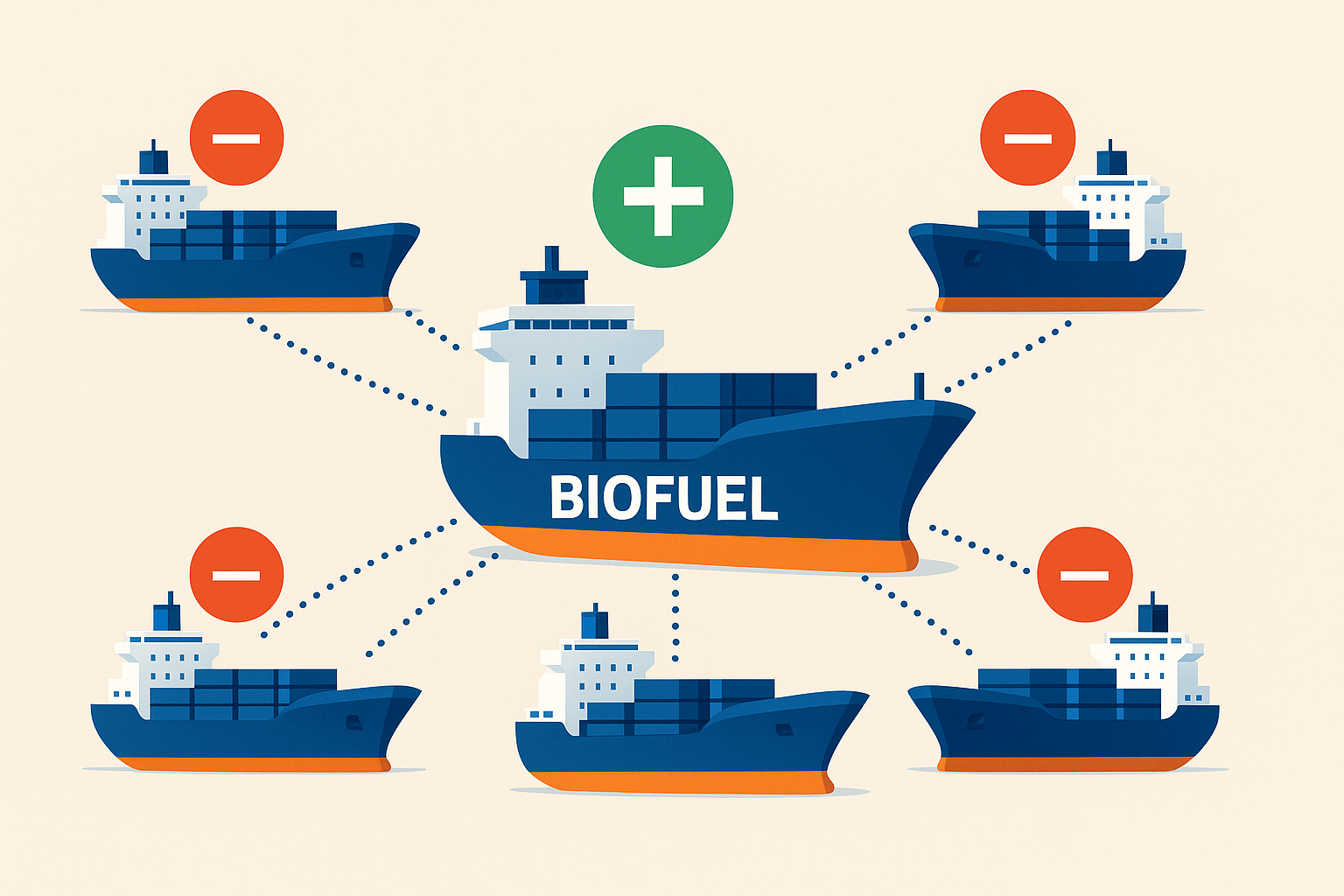
Pooling allows ships to combine their individual compliance balances into a common pool, enabling vessels with a surplus to offset the deficits of others — provided the overall pool remains compliant.
This article explains how pooling works, the rules that apply, how it is verified, and what happens if a vessel remains non-compliant.

What is pooling under Fuel EU?
Under Fuel EU Maritime, each ship has an Initial Compliance Balance based on its greenhouse gas (GHG) intensity performance, and duly verified by the vessel's verifier.
Once this compliance balance is calculated, ships may choose to:
- Enter a pool to offset deficits, or
- Allocate surplus compliance to other ships in the pool.
A pool can consist of two or more vessels, and these vessels may belong to the same company or to different companies.
The key principle is simple:
The total compliance balance of the pool must be zero or positive.
Eligibility to enter a pool
For a vessel to be eligible to participate in a pool, the following conditions must be met:
- The ship must fall within the scope of the Fuel EU Maritime regulation.
- The ship must not have borrowed compliance in the current verification period.
- The ship must be included in only one pool for GHG intensity in a given reporting period.
- The ship must have a valid Fuel EU Document of Compliance from the most recent verification period.
Only vessels meeting all of the above criteria can be included in a pooling arrangement.
Allocation principles within a pool
Once ships are grouped into a pool, the allocation of surplus and deficits is subject to specific rules:
- A ship that enters the pool with a deficit cannot end up with a higher deficit after allocation.
- A ship that enters the pool with a surplus cannot end up with a deficit after allocation.
It is possible for a ship to exit the pool with a remaining deficit, as long as the overall pool balance remains zero or positive.
It is also possible for ships that are already compliant to join a pool purely for the purpose of redistributing surplus compliance among vessels.
Pooling registration and verification
Pooling is not automatic — it must be formally registered and verified.
The process is as follows:
- The company registers its pooling intention in the THETIS database, specifying:
- The ships involved,
- The allocation of the total pool compliance balance, and
- The selected verifier.
- All participating companies (if more than one is involved) must validate the pool setup.
- The verifier then checks:
- That the total pool balance is positive or zero, and
- That surplus and deficits have been allocated correctly according to the rules

If all regulatory conditions are fulfilled, the pool is verified.
After verification, each vessel exiting the pool must still have its individual compliance balance verified.
Note: If a vessel exits a pool with a surplus, that surplus can be banked. This requires two separate verification: one for pooling and one for banking.
Penalties for non-compliance
If a ship fails to achieve a compliance balance of at least zero, a penalty is applied.
- The penalty is set at €2,400 per tonne of VLSFO energy equivalent, or approximately €58.54 per GJ of non-compliant energy use.
- If non-compliance continues into subsequent reporting periods, the penalty increases by 10% for each consecutive period.
This makes pooling not just a flexibility mechanism, but also an important tool for managing financial exposure under Fuel EU Maritime.
Summary of Key Deadlines

Conclusion
Pooling offers operators a practical way to manage compliance across fleets and between companies. It enables efficient use of surplus compliance, reduces the risk of penalties, and provides flexibility in how decarbonisation strategies are implemented over time.
However, pooling also introduces administrative and verification requirements that must be carefully managed. Clear planning, accurate data, and early coordination between stakeholders are essential to ensure that pooling delivers its intended benefits.
At Tecs, we support operators with the data management, compliance calculations, and verification readiness needed to implement pooling and other Fuel EU flexibility mechanisms smoothly and confidently.